Liquid Diving Adventures

Latest News & Updates

Photographing Giant Mantas - Socorro Islands, Mexico

Photographing the World’s Friendliest Mantas


Article by Brandi Mueller ( www.brandiunderwater.com )


As far as amazing underwater encounters go, diving with manta rays is one of the best. These spaceship-looking animals can look almost scary at first glance with their wingspans averaging eight to twelve feet (some documented to be over thirty feet), but as they glide smoothly over the top of a diver exhaling bubbles, it’s easy to see they are really beautiful, gentle creatures. 
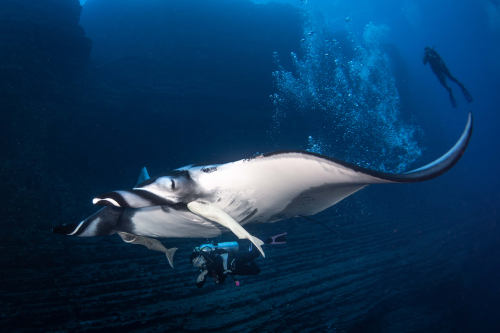


In spite of their massive size, mantas eat plankton, the itty bitty animals we hardly even notice in the water. They use cephalic fins, paddle-like appendages on both sides of their mouth, to funnel in water (and food). Often when they do this they swim in giant loops through the water column, like beautiful acrobatic dancers dressed in black and white. 


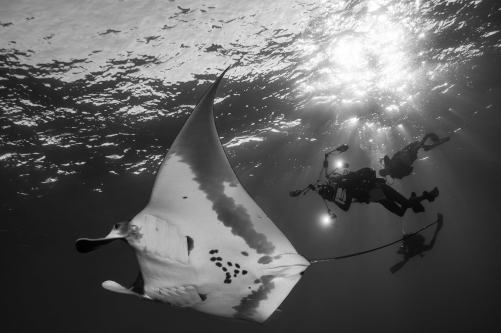
With mostly black back, the undersides of mantas are a pattern of black and white unique and individual to each animal like a fingerprint. There are two types of mantas, black mantas which are mostly black with only a little white on their bellies and chevron mantas which have two white marks on their top side and much more white on their bellies. Images of the manta’s ventral sides have been used to identify and track mantas.


While mantas live in many of our favorite diving locations, including tropical to subtropical waters, we usually only see them if we get really lucky. But around the Revillagigedo Archipelago (known as the Socorro Islands) offshore of Baja, Mexico, divers are almost guaranteed manta sightings, and not just fleeting fly-bys. Known as the world’s friendliest mantas, those residing around Socorro seem to willingly interact with divers, spending entire dives just swimming from diver to diver, making eye contact, and checking the humans out.


The area also has cleaning stations where the mantas get a bit of a spa treatment. Clarion angelfish, cleaner wrasse, and other fish come in to clean the parasites and dead skin off the mantas. This symbiotic relationship helps both parties: the manta gets a good bath and the fish get dinner. For some reason these mantas also seem to enjoy the bubbles divers give off, perhaps it feels like a massage or tickles a bit? The mantas seem to swim right into the bubbles overtop a diver.


Tips for Photographing Mantas

·       Just Breath – The mantas seem to like the massage-like feeling of diver’s exhaled bubbles and they will come around and swim right over top of divers. I almost felt like some manta even seem to take turns with us, visiting each of us, so we all got to see them (maybe they were seeing whose bubbles were best.) So just by exhaling, you can get up-close and personal to take images of these beautiful animals.

·       Don’t Chase – Like any animals, if something seems to be chasing them, they run (or swim) away. Just stay in one spot and wait for the mantas to come to you. Sometimes strong swimming divers can even chase a manta off and it won’t come back for the rest of the dive.

·       Go Fisheye – The mantas are big and they get close. Use your widest, wide-angle lens. Nothing is worse than cutting off a wingtip in an image because the manta was too big and too close to you! For compact camera users, invest in a wet-mount wide-angle lens.

·       Get Settings Ready – The mantas will usually make a similar pattern over divers again and again. Do a few test shots if you can and have your settings and strobes ready to catch the moment you want. And if you missed it, set it up again and usually you just have to wait a little bit before the manta comes back and swims over again.

·       Shoot in Different Directions – I like to stay at the edge of the dive group so that I can shoot into the crowd and get images with divers and then also turn a bit and get shots with the mantas but without divers in the shot. It’s nice to have a variety.

·       Look behind you – Often the mantas are coming into the cleaning station area from the blue and you won’t see them until they’ve passed over you. Always keep an eye out all around.

·       Get Creative – Diving with the Socorro mantas is a rare opportunity where you can expect to have a lot of time and chances to take photos of your subject. Once you have a ton of shots making images in the style you usually do, try something different. Play with your camera settings, adjust your strobe positioning (even turn them off and take some ambient light photos) and strength, take some video. You may not like all the images that come out, but you may get some amazing shots!


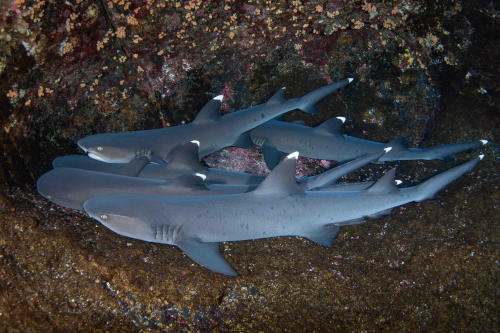
Diving Socorro is not just about mantas either! Divers are likely to see sharks of many species including piles of white tips, hammerheads, silvertips, Galapagos, and while it’s not actually a shark, some lucky visitors may see a whale shark or two. Almost as friendly as the mantas are the dolphins and the islands themselves make for great images too! Socorro should be on every manta-lover and diver’s bucket list. It will not disappoint!


These photos are from a trip Brandi took on the Nautilus Belle Amie to the Socorro Islands December 5-12, 2020. You can book thrips with Liquid Diving Adventures to the Socorro Islands as well as many other amazing destinations worldwide.


Calipso Galapagos Liveaboard - 2021 Discount $1700 Off All Year - Dive Adventure

Calipso Galapagos Liveaboard

2021 Discount $1700 Off All Year


This is a bucket list destination and a super discounted deal. You can book any of the available charter dates throughout 2021 and get a $1700 USD per person discount. Also get FREE nitrox and a 1-night stay in Quito or Guayaquil for ease of transit. These dates must be booked before February 14, 2021.

  • Jan 14th to July 8th, 2021: was $5495 now $3795 p.p
  • From July 8th to Dec 31st, 2021: was $5696 now $3995 p.p


Grand Sea Explorer Liveaboard - Egyptian Red Sea - Save $300 - Dive Travel Adventure

Grand Sea Explorer Liveaboard

Egyptian Red Sea Dive Travel Adventure

Save $300


The Red Sea in Egypt is one of the planet’s most exotic and captivating natural environments. There are few places in the world where you'll find such a diverse array of radiant corals, schooling pelagics, and plentiful marine life along with topside extensions to sites that date to antiquity – it is little wonder that divers refer to the Red Sea as legendary.

We have trip dates in March and April 2021 with a $00 discount from Explorer Ventures and an additional $100 Agent Discount from our team. You must book this package before January 6, 2021 to take advantage of this offer.

Galapagos Master Liveaboard - March 2021 - 30% Discount - Dive Travel Adventure

Galapagos Master Liveaboard 

March 2021 - 30% Discount

Dive Travel "Bucket List" Adventure


We have cabins available on the Galapagos Master Liveaboard for March 2021 with a 30% discount. Travel dates and rates are as follows:

  • 01 - 08 March 2021   7 Days  Was $6150, now $4305 USD
  • 08 - 15 March 2021   7 Days  Was $6150, now $4305 USD
  • 15 - 22 March 2021   7 Days  Was $6150, now $4305 USD
  • 22 March - 01 April 2021   10 days Was $7820, now $5474 USD
Rates are per person double occupancy. Other fees: 
  • Marine Park & Port Fees: $100 USD Galapagos National Park Fees (upon your arrival in the San Cristóbal)
  • Tourist Card: $25 USD (before boarding your domestic flights to the Galapagos visit the INGALA booth at Guayaquil airport)
  • Chamber Support Fee: $35 USD


The Galápagos Islands are an Ecuadorian archipelago of volcanic islands straddling the equator about 970 km west of continental Ecuador. The Galapagos are a UNESCO World Heritage site, an official Ecuadorian province, an Ecuadorian National Park as well as a biological marine reserve.

Socorro Islands - Mexico - Only by Liveaboard!

Socorro Islands - Mexico - Only by Liveaboard!

Mexico’s Revillagigedo Islands are synonymous with liveaboards and big-animal encounters. The archipelago lies about 300 miles off the southern tip of Baja California, requiring a 22-hour transit from Cabo San Lucas.


Four uninhabited volcanic islands make up the Revillagigedos: Socorro, Clarion, San Benedicto, and Roca Partida. They raise up from sea level from 100 to 3,800 feet out of the water from the seafloor, creating exceptional walls, pinnacles and sheer drop-offs that act as cleaning and feeding stations for oceanic mantas and half a dozen shark species, including mass aggregations of scalloped hammerheads.


Revillagigedos is an oasis in the middle of the eastern Pacific. The four islands sit at the convergence of the cool California Current flowing from the north and the warmer North Equatorial Current, creating an ideal spot for nutrients to rise from the deep and attract passing pelagics. This makes Revilla a hotspot for manta rays, humpback whales, whale sharks, dolphins, hammerheads, Galapagos sharks—nearly every variety of hungry traveler.


The Revillagigedos are part of a unique chain with amazing undersea volcanic mounds. Because of the remote nature, there’s just not a lot of pressure on the sites.


Cabo Pierce, the Aquarium, and El Canyon dive sites offer the chance to see just about any big animals you can imagine—humpback whales, pacific bottlenose dolphins, whale sharks, the list goes on.


Because these are important waterways for endangered megafauna, the islands were deemed a UNESCO World Heritage Site in 2016, and a year later were established as the Revillagigedo National Park. Even though they’re remote, they’re patrolled by the local government to prevent illegal fishing.


Because the archipelago is a national park and UNESCO World Heritage Site, certain protective measures are in place. Night diving, solo diving, and diving in the blue are not offered for safety reasons. Also, reef hooks, knives, dive lights not connected to cameras, and gloves are not permitted. In order to manage the number of divers on each site, liveaboards coordinate the timing of their dives. Because of this, if there are several boats at a site, they may limit the number of dives per day to three. The park has a set limit on the number of liveaboards that can visit, but flexibility is key in these parts.


Previous Posts